In 1206, Ismail al-Jazari completed one of the most remarkable illustrated engineering works of the medieval world. Known in English through Donald R. Hill’s translation as The Book of Knowledge of Ingenious Mechanical Devices, it explains fifty devices in six categories: clocks, ceremonial vessels, washing and medical-measuring apparatus, fountains and musical automata, water-raising machines, and a final group of miscellaneous constructions.
Short answer: this was not merely a gallery of inventions. It was a structured record of how mechanisms were conceived, built, adjusted and made intelligible through text and drawings. The book connected practical craft with systematic knowledge—an idea expressed in its longer Arabic title, al-Jāmiʿ bayn al-ʿilm wa-l-ʿamal al-nāfiʿ fī ṣināʿat al-ḥiyal: a compendium joining knowledge with useful practice in the making of mechanical devices.
The popular phrase “the book of fifty ingenious devices” describes its contents, not its exact historical title. That distinction matters: al-Jazari was preserving an engineering method, not simply collecting curiosities.
Al-Jazari’s enduring achievement is the union of mechanism, documentation, visual explanation and human experience in one engineering work.
A book made at the Artuqid court
Biographical evidence about al-Jazari is limited. Manuscript catalogues identify him as Badīʿ al-Zamān Abū al-ʿIzz Ismāʿīl ibn al-Razzāz and place his documented activity roughly between 1181 and 1206. Widely repeated birth and death dates should therefore be treated with more caution than the secure evidence supplied by the book and its manuscript tradition.
Al-Jazari worked at the Artuqid court in Amid, present-day Diyarbakır. The treatise was prepared for the Artuqid ruler al-Ṣāliḥ Nāṣir al-Dīn Maḥmūd. The court was not just a backdrop: clocks, fountains, dispensing vessels and automata performed practical, ceremonial and representational roles. They measured time, moved water, served guests and made technical command visible.
Academic studies date the completed work to 602 AH / 1206 CE. A manuscript colophon discussed by historians gives a completion date in January 1206, while the celebrated Topkapı manuscript Ahmet III 3472 is also dated to that year. The safest historical statement is therefore clear: the book belongs to the Artuqid court at the opening of the thirteenth century and was completed in 1206.
Why there are exactly fifty devices
Al-Jazari organized the work into six categories rather than presenting an unstructured sequence. The arithmetic is deliberate: the first four categories contain ten devices each, and the last two contain five each.
1. Water clocks and candle clocks — 10 devices
These chapters treat machines that indicate the passage of time through controlled water flow, floats, cords, pulleys, counterweights, moving figures and visual or audible signals. The elephant clock, castle clock, scribe clocks and candle clocks belong to this family.
2. Vessels and figures for drinking sessions — 10 devices
These are courtly service and entertainment mechanisms: vessels that dispense liquids in controlled ways, figures that pour or present drinks, and devices in which concealed hydraulic or pneumatic actions create an ordered performance.
3. Pitchers, basins and measuring devices — 10 devices
This group includes apparatus for hand washing and ritual cleansing, together with a device associated with measuring blood collected during phlebotomy. Their engineering interest lies in timed delivery, level indication, concealed valves and coordinated sequences.
4. Fountains and musical automata — 10 devices
Here al-Jazari describes fountains whose patterns change and mechanisms that use water and air to sustain musical effects, including “perpetual flute” devices. The chapters show how flow can be converted into alternating motion, sound and spectacle.
5. Machines for raising water — 5 devices
These machines lift water from pools, wells or rivers using animal power, water wheels, chains of pots, gears, cranks and pumping arrangements. The group moves most visibly from courtly display toward agricultural and infrastructural work.
6. Miscellaneous constructions — 5 devices
The final category contains a monumental cast-metal door, a protractor, a letter-based combination lock for a chest, a multi-bolt door lock and a boat clock. “Miscellaneous” does not mean minor: it shows how al-Jazari’s method could move from architecture to instruments, security mechanisms and portable timekeeping.
How one chapter works like an engineering document
The book is historically important because its units are not only descriptions of finished objects. A typical chapter begins with the purpose and general appearance of a device, then moves into its parts, dimensions, relationships, assembly and operation. Drawings are integral to the explanation.
Modern readers should not expect a present-day CAD model, tolerance scheme or manufacturing standard. Materials, workshop practice and conventions belonged to a different technical world. Yet the underlying documentation logic is strikingly familiar:
- define what the device is meant to do;
- divide the whole into named components;
- show spatial relationships through drawings;
- explain the sequence of operation;
- identify adjustment and timing relationships;
- connect visible behaviour to concealed mechanisms;
- preserve enough knowledge for reconstruction and study.
This is why the book should be read as technical communication as well as history of invention. Its ambition was to make working knowledge transferable.
The elephant clock: an engineered sequence, not a static image
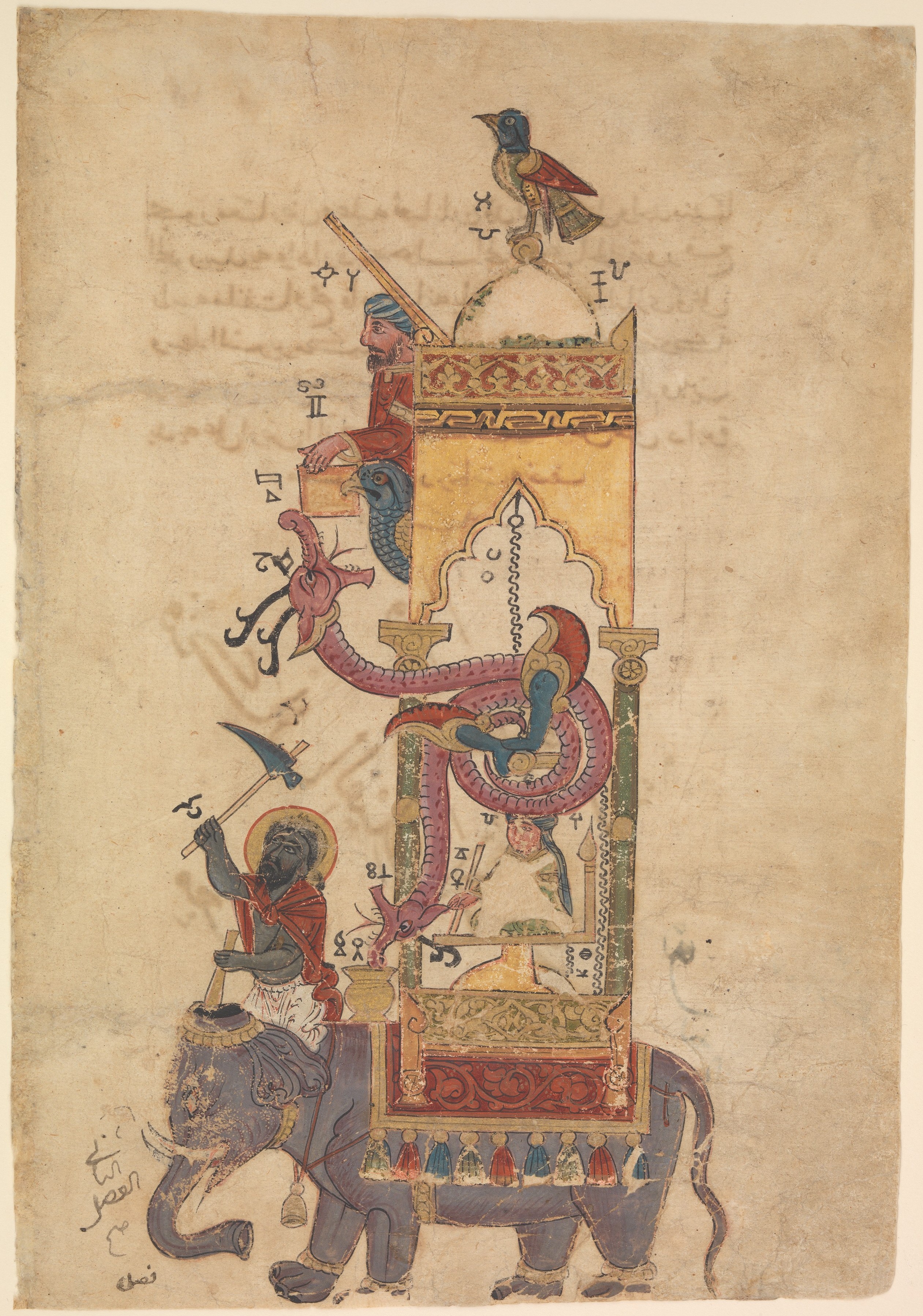
The elephant clock is now the best-known image associated with al-Jazari. Its popularity can hide the engineering point. The clock is a timed sequence of energy and signals.
Inside the elephant, a floating vessel descends as water enters it. Its movement releases a ball and activates cords, figures and sound-producing actions. The visible drama—driver, birds, serpentine dragons and upper figures—depends on the controlled rate of an unseen hydraulic process. Time is translated into motion, then into an event that people can see and hear.
The surviving folios also remind us that the image most people recognize is not the physical machine and not necessarily a page drawn directly by al-Jazari. The Metropolitan Museum’s public-domain folio used for this article is from a manuscript dated 715 AH / 1315 CE, copied more than a century after the book was completed.
From clocks to water supply
The fifty devices reveal a common engineering vocabulary applied to different purposes.
- Floats and regulated flow turn water level into a timing signal.
- Siphons and concealed channels control when liquid starts, stops or changes path.
- Pulleys, cords and counterweights transmit motion and reset figures.
- Gears and rotating elements change direction, speed or type of motion.
- Valves and chambers organize delivery, pressure and sequence.
- Mechanical figures make internal state legible to an audience.
- Sound and movement become part of the interface, not decoration added after the mechanism.
The water-raising chapters are especially valuable because they show the same disciplined attention applied to useful work. The final machine is a water-wheel-driven pump, described in the modern Hill edition as a distinct chapter. It is legitimate to discuss its cranks, connecting elements and pumping cycle; it is less responsible to turn it into a simplistic claim that one person “invented the modern engine.” Mechanical history develops through transmission, adaptation and many surviving or lost traditions.
Automata are not the same as modern robots
Al-Jazari’s moving servants, musicians, birds and time-indicating figures are correctly described as automata: mechanisms that perform predetermined actions through hydraulic, pneumatic and mechanical control.
Calling them “robots” can help a modern audience imagine their effect, but the word is anachronistic if left unexplained. These devices had no electronics, digital computation or general-purpose autonomy. Their importance lies elsewhere: they embodied sequence control, feedback from water level or position, repeatable action, human-facing signals and carefully staged interaction.
The most accurate formulation is that al-Jazari’s book is a major source for the history of automata and mechanical control. It should not be burdened with unsupported claims of being the single origin of every later robotic technology.
A manuscript tradition that carried engineering knowledge
The book survived because it was copied, illustrated, translated and catalogued across centuries.
- Topkapı Palace Library, Ahmet III 3472: dated to 1206 and regarded by specialists as the earliest known manuscript witness. Questions about its production, authorial relationship and later additions remain matters of scholarship.
- The dispersed 1315 manuscript: copied by Farrukh ibn ʿAbd al-Latif and once containing around 150 folios with numerous diagrams and paintings. Pages are now held in several collections, including The Metropolitan Museum of Art.
- British Library Or 116: an eighteenth-century Arabic manuscript digitized by Qatar Digital Library. Its 153 folios preserve text, diagrams and illustrations, while also showing losses and later mounting of some images.
- The 1974 Hill edition and translation: Donald R. Hill’s English translation, published as The Book of Knowledge of Ingenious Mechanical Devices, made the work widely accessible to historians of technology and engineering readers.
These witnesses are not interchangeable photographic copies. Illustrations vary, some diagrams are incomplete, and manuscript histories must be studied rather than flattened into one “original picture.” That variation is part of the history of technical knowledge.
Ten lessons for engineers today
The book does not provide modern production files, but its working principles remain relevant.
- Join knowledge to practice. A mechanism is not understood until the explanation survives contact with construction and operation.
- Begin with function. The reader is told what the device should achieve before being taken inside it.
- Break complexity into parts. Large performances are built from reservoirs, floats, channels, triggers, cords, wheels and figures.
- Document the sequence. Static geometry is not enough for a machine whose value lies in timed actions.
- Make internal state visible. A pointer, figure, sound or changing fountain pattern tells the user what the mechanism is doing.
- Design the interface with the mechanism. In the clocks and automata, user experience is inseparable from the energy and signal path.
- Account for adjustment. Flow, balance and timing need calibration, not only assembly.
- Cross disciplines. Metalwork, woodwork, hydraulics, geometry, decoration and performance meet in one system.
- Preserve provenance. Drawings and explanations keep a device connected to its author, patron, place and purpose.
- Treat documentation as infrastructure. A fragile machine can disappear; a well-structured technical record can continue to teach.
Why this heritage matters to JAZARION
JAZARION takes its name and part of its engineering identity from Ismail al-Jazari. That heritage is not a licence to place modern claims into a medieval manuscript. It is a responsibility to carry forward the relationship between imagination, useful engineering, clear documentation and collaborative making.
In a contemporary project, the equivalent record may include requirements, CAD data, material decisions, interfaces, calculations, manufacturing review, inspection evidence and revision history. The tools have changed; the need to connect knowledge with useful practice has not.
JAZARION develops this principle as a global engineering and manufacturing ecosystem: ideas should become reviewable engineering definitions, and approved definitions should remain connected to production, quality and learning. Historical study belongs beside present-day engineering work because it teaches how technical knowledge survives, travels and becomes actionable.
Explore the JAZARION community and Academy, develop an engineering idea in Concept Studio, or consult the CAD Library.
Frequently asked questions
Was the book actually titled “Fifty Ingenious Devices”?
No. That is a useful modern description of its contents. The work is known by Arabic titles including Kitāb fī maʿrifat al-ḥiyal al-handasiyya and the longer al-Jāmiʿ bayn al-ʿilm wa-l-ʿamal al-nāfiʿ fī ṣināʿat al-ḥiyal. Hill’s English edition is titled The Book of Knowledge of Ingenious Mechanical Devices.
When was al-Jazari’s book completed?
The work was completed in 602 AH / 1206 CE at the Artuqid court in Amid, now Diyarbakır.
Does the book contain exactly fifty devices?
Yes. There are fifty device chapters grouped into six categories: 10 + 10 + 10 + 10 + 5 + 5. A modern publisher’s table of contents may count introductory or back-matter sections differently, but the engineering programme itself contains fifty devices.
What kinds of devices are described?
Water and candle clocks, dispensing and washing vessels, measuring apparatus, fountains, musical automata, water-raising machines, locks, a protractor, a monumental door and a boat clock.
Did al-Jazari invent the robot?
The book is a foundational source for studying mechanical automata and control sequences. Calling al-Jazari the sole inventor of the modern robot is historically imprecise because “robot,” electronics and programmable computing belong to much later contexts.
Where can the manuscript be viewed?
Qatar Digital Library provides unrestricted online access to British Library manuscript Or 116. The Metropolitan Museum of Art publishes public-domain images and catalogue records for folios from the 1315 manuscript. The 1974 Hill translation is catalogued by Springer.
Sources and further reading
- Qatar Digital Library — British Library Or 116 manuscript record and digital facsimile
- The Metropolitan Museum of Art — 1315 elephant-clock folio, object 57.51.23
- The Metropolitan Museum of Art — 1315 waterwheel folio, object 55.121.11
- Springer — Donald R. Hill edition and English translation, 1974
- CNRS Éditions / OpenEdition — study of the book’s structure and technical communication
- Max Planck Institute ISMI — Topkapı Ahmet III 3472 manuscript record
- South Asian Studies — research on manuscript transmission and translation
Historical note: this article distinguishes documented manuscript evidence from later popular claims. The cover image is a public-domain folio dated 715 AH / 1315 CE, The Metropolitan Museum of Art, Bequest of Cora Timken Burnett, 1956, object 57.51.23.