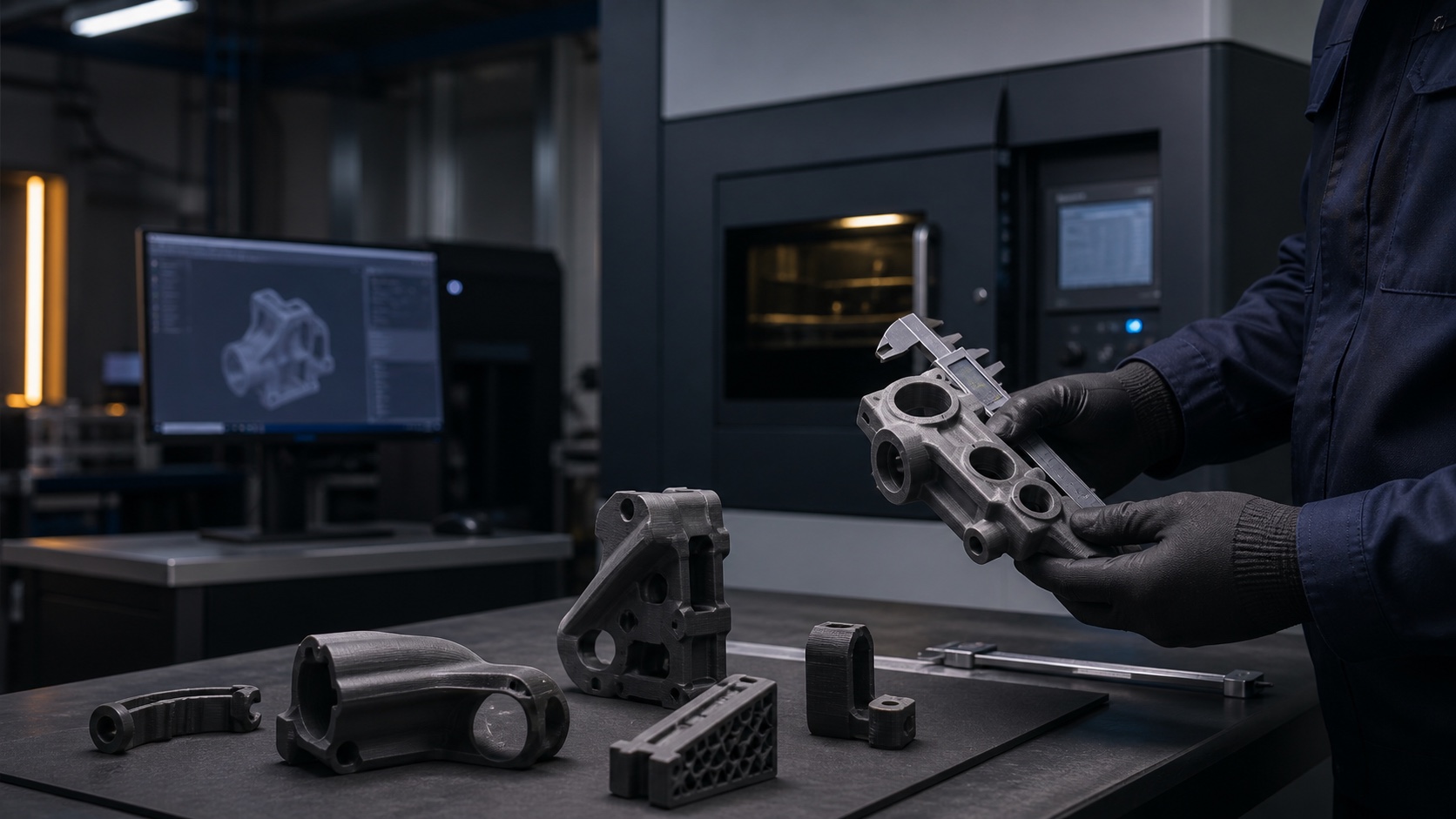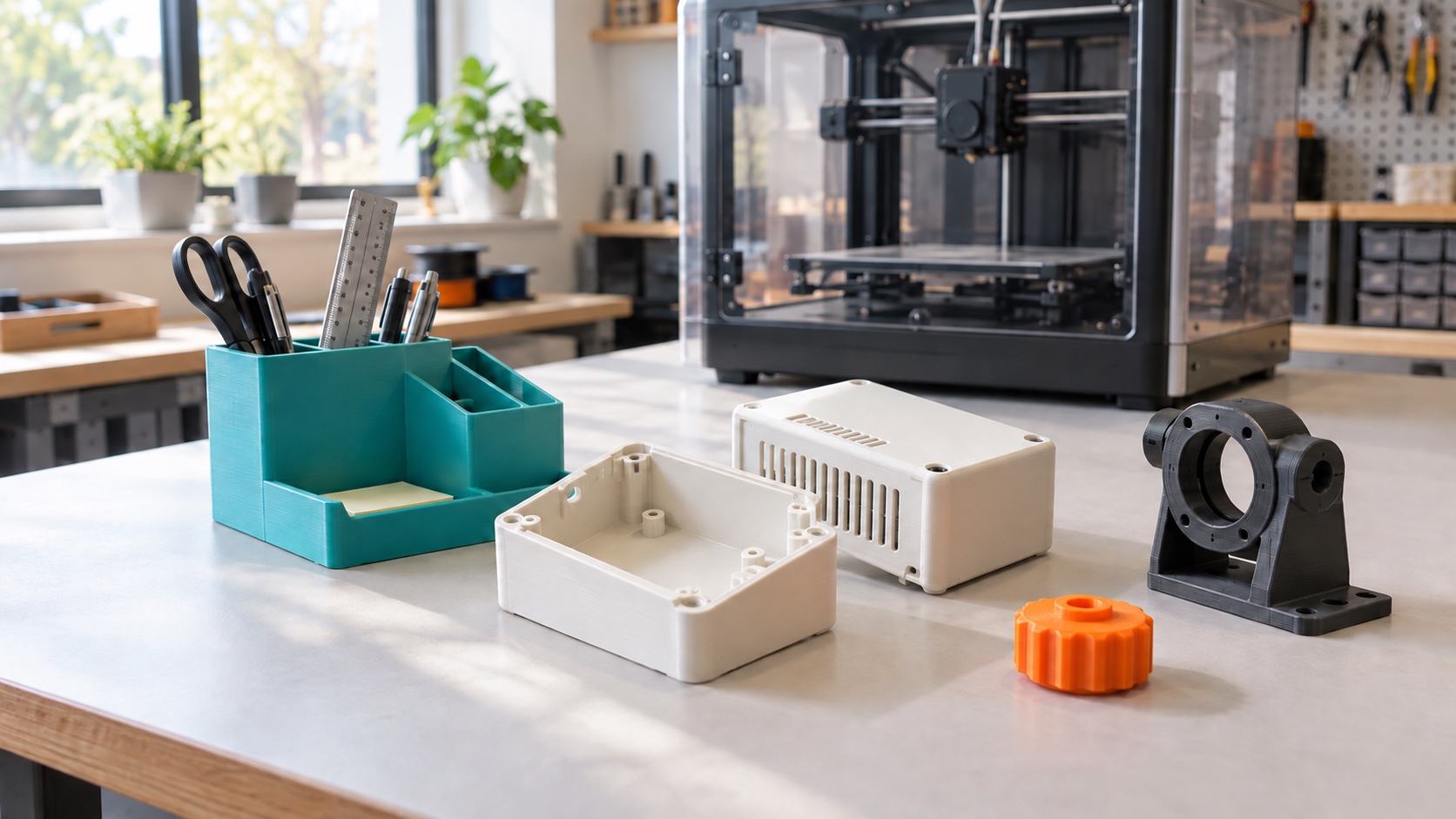
AI-generated editorial illustration: useful polymer parts and a 3D printer.
A small plastic clip breaks. The rest of the product still works, but the replacement part is unavailable. Or perhaps you have the opposite problem: an idea for something useful that nobody seems to sell.
Both situations raise the same question: could you simply print the part?
Yes—3D printing can make custom organisers, holders, selected replacement parts, enclosures, models, prototypes and workshop fixtures. But producing the shape is only part of the job. The material, dimensions, loads, temperature and manufacturing process determine whether the result will actually work.
You do not need to own a printer to explore the idea. You need to describe what the object should do.
Technical sources and the JAZARION service page were checked on 17 September 2026. The examples below illustrate possible projects, not certified designs or completed customer orders.
How does 3D printing work?
3D printing builds an object from a digital model by adding material in successive layers. This is the basic principle of additive manufacturing, as described by the US National Institute of Standards and Technology. NIST
Think of the model as a description of the intended shape. Manufacturing preparation translates it into instructions for a particular process. Printing is followed by whatever cleaning, finishing, assembly and inspection the part requires.
The useful distinction is between making an object that looks right and making a component that performs correctly. A display model and a working bracket may resemble each other while requiring different materials and checks.
Eight useful things you can 3D print
1. Organisers that fit your actual space
Drawer dividers, cable guides, tool trays and holders can be designed around the dimensions you have. Customisation matters when a standard product wastes space or leaves an awkward gap.
Start by measuring the available space, including clearance to insert and remove the organiser. Decide which dimensions must fit precisely and which can vary.
2. Stands and mounts for a specific setup
A desk stand, camera accessory or sensor holder can solve a small but persistent positioning problem. The important questions are what it holds, how it attaches and what forces it experiences.
A holder on a quiet desk and a mount on vibrating equipment are different engineering tasks, even if the drawings look similar.
3. Selected replacement parts
A missing knob, cover or non-critical clip may be a candidate after its function is understood. A broken sample helps describe the geometry, but copying its shape does not prove that the replacement will last.
Ask why the original failed. Was it overloaded, exposed to heat or repeatedly flexed? Recreating the same weak feature may recreate the same failure. Safety-critical components need a separate engineering and validation route.
4. Enclosures for prototypes
A custom enclosure lets you check whether connectors, buttons, cables and internal parts fit together. A physical prototype can reveal assembly problems that are easy to overlook on a screen.
For a working product, requirements such as heat, electrical protection and environmental exposure need to be addressed explicitly. A neat-looking box does not establish that they have been met.
5. Scale models and learning objects
Architectural models, sectioned mechanisms and demonstration pieces can make a concept easier to understand. Here the goal might be visual clarity rather than long-term mechanical performance.
Decide what the model must communicate. An enlarged feature or detachable section may explain the idea better than a strictly scaled copy.
6. A first physical version of a product idea
Before committing to production, a prototype can help answer simple questions: Is the handle comfortable? Can the cover be opened? Does the part fit its neighbour?
Write down the question before making the prototype. A model intended to check appearance should not quietly become evidence of load-bearing capability.
7. Workshop fixtures and positioning aids
A fixture holds or locates something during an operation. A printed tray, assembly locator or checking aid may simplify repetitive work when its accuracy and operating conditions are suitable.
Define how wear will be detected and which surface establishes the position. If an inaccurate fixture can create a batch of inaccurate parts, the fixture itself needs verification.
8. Small batches of customised parts
Several versions of a housing, personalised layouts or a short initial batch may be worth evaluating for printing. The attraction is the ability to vary geometry without committing to a separate mould for every design.
That does not make printing automatically the cheapest route. Compare complete quotations for the same quantity, finish and inspection requirements.
Which printing process should you choose?
3D printing is a family of processes. For example, material extrusion deposits material through a nozzle, vat photopolymerisation cures a liquid resin, and powder-bed fusion joins selected regions of a powder layer. NIST technology overview
For a first enquiry, you do not have to choose the machine. Use this table to describe the result you need:
| Your priority | What to tell the manufacturer |
|---|---|
| A model that looks convincing | Visible surfaces, fine details, colour and finish |
| A part that must fit another part | Mating geometry, critical dimensions and allowed variation |
| A working component | Loads, movement, temperature and expected service conditions |
| Several consistent pieces | Quantity, repeatability requirements and inspection scope |
JAZARION's plastic 3D printing page presents FDM, SLA, SLS and MJF as routes to compare. The final process, material and build orientation are subject to engineering review. Explore the service
Are 3D-printed parts strong enough?
There is no useful yes-or-no answer without an application. “Strong enough” for a desk organiser is different from “strong enough” for a repeatedly loaded bracket.
For filament printing, build orientation and geometry can affect part integrity; Prusa's design guidance explicitly discusses those effects. A material name alone does not describe the performance of the finished object. Prusa design guide
Give the manufacturer a description of the load and environment. Identify the consequence of failure. Then agree on what evidence is needed: a fit check, dimensional inspection, functional test or a more demanding qualification process.
For a replacement part, “it fits” is a useful first result. It is not the final answer to “will it work over time?”
Can you print metal—or anything at all?
Metal printing exists: EOS, for example, describes a laser powder-bed process. It requires suitable equipment and controls. An ordinary plastic filament printer does not become a metal manufacturing system simply because a model file is available. EOS
Nor does a digital model guarantee manufacturability. Size, geometry, required properties, finishing and inspection may make another route more suitable. Some products are assemblies: printing their outer form does not create working electronics, bearings or motors inside them.
Treat “Can it be printed?” and “Should it be printed?” as separate questions.
Is 3D printing cheaper than buying or moulding a part?
Compare the total cost for the actual requirement. Include model preparation, manufacture, finishing, inspection, delivery and any iterations. A low material bill is not the same as a low project cost.
Published comparisons are case-specific. Formlabs' printing-versus-moulding example uses a particular part, machine and cost assumptions. Its result is not a universal break-even quantity for other projects. Formlabs comparison
For an ordinary part already available in the right specification, buying it may be simplest. Printing is worth exploring when the geometry is custom, availability is a problem or you need to learn from a prototype before committing to a larger run.
A five-question check before you print
- What must the object do? Separate appearance, fit and working performance.
- What must it fit? Provide dimensions and the neighbouring parts or interfaces.
- What will it experience? Describe loads, temperature, moisture, sunlight and repeated motion where relevant.
- How many do you need? Include the quantity now and any expected later batch.
- How will you accept it? State what you will measure or test to decide whether the part works.
Consider an illustrative project: a custom holder for a desk-mounted sensor. “Print this shape” leaves open the cable route, fixing method and orientation. “Hold this sensor in this position, with access to these connectors” gives the designer a problem that can be checked.
That change—from a picture to a clear function—is often the most valuable first step.
From a useful idea to a manufacturing enquiry
JAZARION is the global industrial platform of EXP OMNIVERSE. For a plastic printing enquiry, its current workflow lets you attach a model and specify function, quantity and inspection needs. Geometry, availability, price and delivery are confirmed after review, rather than by submitting the form alone.
If you have a model, start with a 3D printing enquiry. If you are still defining the idea, explain the function and missing information in a project request. For the ordering steps, read how to order plastic 3D-printed parts through JAZARION.
The best first project is not necessarily the most impressive object. It is a small, clearly defined problem for which you can recognise a successful result.
Frequently asked questions
What are useful things to 3D print for beginners?
An organiser, desktop stand or simple visual model can be a manageable starting point. Choose a task with clear dimensions and low consequences if the first version needs improvement.
Do I need my own 3D printer?
No. You can send a project to a manufacturing service. A usable model and clear requirements still need to be prepared before production.
Can a broken plastic part be copied?
Sometimes. Its geometry, function and cause of failure must be understood. Matching the shape does not establish equivalent material properties or service life.
Can I print from a photograph?
A photograph can help explain an idea, but normally does not define all dimensions and hidden surfaces. A usable 3D model and checks of critical dimensions are still needed.
How much does a 3D-printed part cost?
Cost depends on geometry, quantity, process, material, finishing, inspection and delivery. Request a quotation against a defined specification rather than judging by size alone.
Do I have to design the model myself?
No, but a model suitable for the task must be prepared before manufacture. You can start with a functional description or a dimensioned sketch, then identify the engineering work needed to complete it.
Is a printed prototype ready for production use?
Only if it has been evaluated for that use. A prototype made to check shape or assembly should not automatically be treated as a qualified working component.